*Memories of Matsuko is part of East Winds: A Third Window Film Festival. This review has been produced for CUEAFS and is published on iCov here
Alternative title: Kiraware Matsuko no issho Written and directed by: Tetsuya Nakashima Starring: Miki Nakatani, Eita and Yusuke Iseya
A visually and cinematographically captivating enchanted world of music and joy, love, pain and fundamental values is what Tetsuya Nakashima delivers to the viewer with his 'Memories of Matsuko'. The 'Kamikaze Girls' director takes 'Amelie' a step further and his magic exceeds even the screen splendour of 'Avatar', while the combination of drama and comedy fascinates the audience and turns them into a dedicated fan of this tragically everlasting hopeless hopefulness.
Narrated through the eyes of young Shou, entangled in his late aunt's garbage, trying to put together the pieces of her life, the film is a touching tale about Matsuko and her undying faith in the good of people. Matsuko's quest for happy endings is born through her desperate efforts to receive attention and affection from her father, who rarely spares a smile for her in his care for her chronically ill sister Kumi. Tainted with the burden of her pointless attempts to receive a manifestation of love, which inevitably contaminates all her relationships with men, Matsuko goes on a quest to find an ultimate meaning, and despite her downfalls, to learn to pick the pieces and turn them into beautiful songs that become her life-support machine.
Director Nakashima, who has proven his visual brilliance with his previous 'Kamikaze Girls' and 'Paco and the Magical Book', creates yet another simply absurd, imaginative and unreal fabulous world. The different periods of Matsuko's life follow their own colour scale and paint the screen with everything from warm bright pink under the joyful sounds of optimistic songs to the dark and depressing notes with splashes of crimson blood. From the beginning to the end, the audience is thrown into a surreal mixture of colours and sounds, set as a background to a very real and tangible drama and plausible life experience, which is where the actual sadness of the film lies.
From her desire to be a perfect daughter and sibling, perfect girlfriend, wife and bar hostess, to being a perfect prostitute, Yakuza girl or prisoner, Matsuko's failures build one atop the other and Nakashima depicts a heart-twisting journey that is beautiful and tearful at the same time. Her character's drama lies in her utmost desire to find stability and success and the almost tangible emptiness of the search for happiness taints her existence. Matsuko's tragedy is evident in her inability to accept her fate and in her dedication to finding the impossible perfect happiness with utmost efforts, and set on the downward spiral of her life, she becomes victim of the attempt to unlock the undecipherable secrets of life, love and the meaning of it all.
Miki Nakatani is simply brilliant in portraying the fragile human being desperate to fit in a world of porn stars, pop and Yakuza gang members and to find a path to happiness. Her portrayal of a hopelessly hopeful romantic whose attempts at perfection break so easily and leave her life fractured and bruised, only to ignite her dedication even more, is simply flawless. Nakatani's transformation into the dispirited broken girl whose heart still holds the painful particles of a hope long lost, is the final drop of true emotion that is delivered to the audience to turn this beautiful magical world of Nakashima's into a tragedy about the fundamental existential truths. Combined with the heart-melting score by Italian composer Gabriele Roberto, Memories of Matsuko turns into a refined visual and musical masterpiece with a meaningful tragicomic beautiful story underneath; a film that leaves a long-lasting aftertaste in one's mind, having touched the boundaries of human emotion.
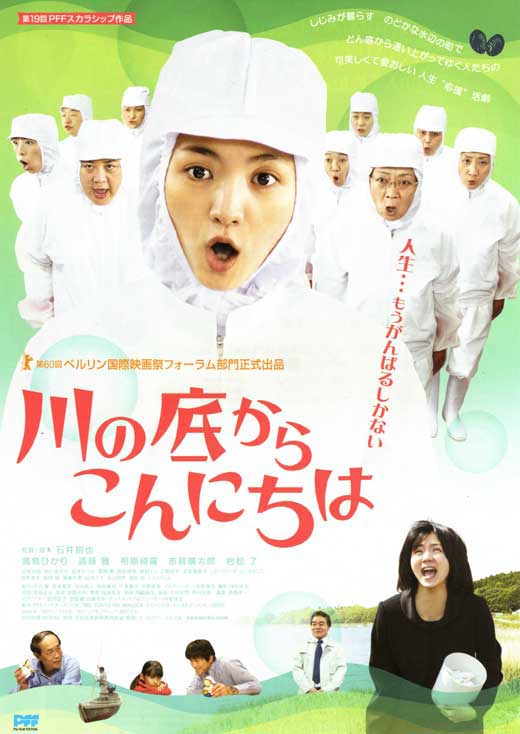
Alternative title: Kawa no soko kara konnichi wa Written and directed by: Yuya Ishii Starring: Hikari Mitsushima, Kotaro Shiga and Masashi Endo
The newest Japanese film picked up for international release by distribution company Third Window Films, official sponsor of Coventry University East Asian Film Society (CUEAFS), ‘Sawako Decides’ by director Yuya Ishii portrays something different than what Western audiences would classify as ‘comedy’. The film deals with complicated emotions and personalities, and tells a universally true message about life and the will to live it.
Hikari Mitsushima (‘Kakera’, ‘Love Exposure’) portrays a spiritless girl during her fifth year in Tokyo, a ‘middle’ woman in a ‘middle’ job with a ‘middle’ boyfriend, who uses the phrase ‘it cannot be helped’ as an excuse for her apathy towards her own existence. At her meaningless and humiliating job at a toy company, she passively listens to two co-workers talk about men and the global economic crisis. Her free time she spends drinking beer alone or in the company of her boyfriend Kenichi and his daugher Kayoko, unable to connect with either of them in any significant way. With the news of her father being desperately ill, Kenichi persuades Sawako to move back to her home town and take over the clam-packing company her father used to run. Faced with the strong personalities of the factory women and the townspeople accuing her of deserting her father, Sawako slowly sinks into her ordinary life until one day she decides that it’s time her life changed.
Despite its slow pace , the film picks up speed towards the end, where the ‘metamorphosis’ of Sawako takes place. In that last part isn’t short of a few laughs and, perhaps, a few tears. Hikari shows her more active side which is visible in her performance in ‘Love Exposure’ and wins hearts with Sawako’s innocent eyes filled with childlike optimism, based on a depressing middle-class opinion of her own life. The music score debut by Chiaki Nomura and Samon Imamura is absolutely brilliant at closely following the pace of the film and intensifying the hidden emotions of the unsuspecting audience.
Hikari Mitsushima received Best Actress awards for her unforgettable performances in ‘Love Exposure’ and ‘Kakera’, and here gives a memorable impression of a spiritless middle-class girl, undergoing metamorphosis. Her portrayal of Sawako is very similar to the personality of Haru from ‘Kakera’ although directors Momoko Ando and Yuya Ishii created two completely different films in nature, storyline and message. Hollywood audiences might find a recent role undergoing the same metamorphosis in Darren Aronofsky’s ‘Black Swan’, where Natalie Portman’s character fights a similar battle with her own mind, although the film is again very different in nature and ideology. Although Sawako’s metamorphosis might seem a bit sudden and unrealistic and her character might be one that’s difficult to identify oneself with, Hikari Mitsushima’s performance in both parts of the film is truly believable and the audience can’t help but sympathise and want more for this middle-class girl leading a middle-class life.
With the only criticism as to running time, which could be slightly edited due to the film’s pace, ‘Sawako Decides’ is pleasant to watch and even though a little different from what is usually called a comedy, able to create a few laughs and leave the audience with perhaps a little more optimism as to their own lives. Although at times the characters might not be easy to identify with and their seemingly numb and meaningless lives might be somewhat unbelievable, the actors are convincing in their performances and with the help of the brilliant soundtrack are able to transcend the audience into the ‘middle’ world, where no-one is special, but life is still worth living.
*This review has been produced for CUEAFS and our partners Cine-Vue
The review has been submitted to Cine-Vue; still unpublished
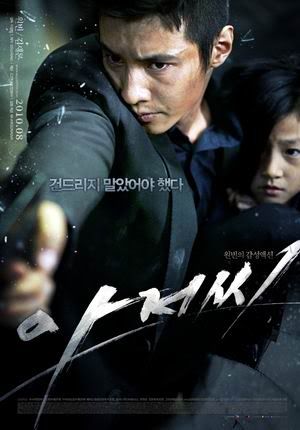
Alternative title: Ajeossi Written and directed by: Leong-beom Lee Starring: Bin Won, Sae-ron Kim and Thanayong Wongtrakul
What starts out as a slow-paced ordinary story with not much to put one's finger on, besides the obvious appealing coolness and charm of the lead character, turns into a dramatic combination of drama, exhilarating fight sequences and multi-layered character development in the South Korean action thriller “The Man from Nowhere”. Director Jeong-beom Lee uses a well-known story of a skilled man on a journey to rescue a loved one, supplementing the storyline with a few side elements and intricate camera movements that add colour to the plot and tincture to the characters.
The film begins with the depiction of the main characters, leading seemingly unconnected lives. Cha Tae-Sik (Bin Won, “Mother”) is a quiet pawnshop owner who has withdrawn himself from society after a personal tragedy has struck him, whose only link to the outside world is the little girl next door, So-Mi. When the girl is kidnapped, her mother is murdered and her organs are harvested, Cha sets on a bloody journey that will lead him out of the shadows and will turn him into a dark knight who will fight all evil in his quest to rescue the child, finding unknown love in his heart for his 'next door neighbour'.
One might see in this film the shades of other productions such as Tony Scott's “Man on Fire” or Luc Besson's “Leon: The Professional”, with fight sequences similar to the Bourne trilogy and a man's determination to take justice in one's own hands which reminds of “Law Abiding Citizen”. However, “The Man from Nowhere” does not fall under the shadow of those films, but builds its own identity and convinces with its dark gloomy mood and believable characters. With the addition of the one-dimensionally evil gangsters, a sometimes cheesy dialogue and a happy ending, the film is truly a two-hour delight entrenched within the action thriller genre.
Bin Won is incredible in his performance, exhibiting his wonderful array of acting talents in the portrayal of a character so deeply different from Yoon Do-joon in “Mother”. His exquisite display of a range of emotions is absolutely beautiful – from downfall and devastation to ruthlessness and mercilessness and sympathy and affection. His posture and the way his seemingly untouchable coolness breaks down so easily and unexpectedly from the pain he feels, is admirably portrayed by Bin Won, and even more so impressive are his too-quick-for-the-eye-to-see fighting techniques.
Sae-ron Kim who plays So-Mi does not fail to carry her role charmingly well and compliments the brilliance of Bin Won. She adds youthful energy to the plot and a type of dramatic compassion that only a child could provoke. Her character is not overly emotion-tinted, but believable and genuine, and her presence sheds light on a different layer of Cha's character, whose affection for the girl is spectacularly made obvious even before he sets on his revengeful journey in the name of her rescue.
What starts out as a medium to unnoticeable performance by Thanayong Wongtrakul, who plays Ramrowan, turns into an impressive side story that interweaves with the main plot in an unforced natural way. Ramrowan's only lines in the film refer to his admiration of the lead character, and Thanayong does a beautiful job expressing his awe for a worthy adversary throughout the rest of the film without saying a word. The final fight is a battle of honour between two matching opponents to determine superiority, which has its roots in a deeply Oriental and traditionalist understanding of honour and excellence. His emotional transformation adds a different shade to the story, with his sympathy and sadness for the little girl bringing him to oppose his anti-hero statute and be human.
Beautifully scripted and beautifully executed, “The Man from Nowhere” is a delightful symbiosis of delicate threads of different stories that flow alongside one another and interweave in an genuine and believable manner. There is not one place in the film where the action or dialogue is unnecessary, over-acted or cheap, and the amazing score builds onto the drama and adds intensity to the scenes. A revenge film, which is not mean-spirited, an exhilarating action film with fragments of moderate drama and a familiar story with a softer flow and multi-layered characters – these are the elements of “The Man from Nowhere” that set it far apart from other similar productions and turn it into a splendid depiction of fighting excellence and emotional devastation with character and story development that does not fail to impress and touch one's mind and heart.
*This review has been produced for CUEAFS and our partners Cine-Vue
The review has been submitted to Cine-Vue; still unpublished
Directed by: Wilson Yip Written by: Edmong Wong Starring: Donnie Yen, Sammo Hung and Simon Yam
Master of the Chinese martial arts and Hong Kong action star Donnie Yen delivers another incredible performance in this sequel to the biopic “Ip Man” from 2008. Wilson Yip returns in the director's chair to continue the story of Ip Man's life from where the previous film ended and tell the story of the martial arts teacher's struggles in a post-war world.
Following his assault on the Japanese Army, Ip Man moves to Hong Kong in 1949. Because of his financial troubles, he tries to open his own martial arts school, only to encounter more problems along the way. After competing with the other masters to 'deserve' his right to teach kung fu, Ip Man comes face to face with the foreign culture of the British, who have no respect for anything that martial arts teach. Integrating loosely the story of Ip Man's relationship with his first Hong Kong pupil, Leung Sheung, or even arguably with Bruce Lee, the film's plot is a little too similar to the original, where Ip Man's patriotism against the invading Japanese is replaced by a not-subtle-enough nationalism against the foreign culture of the West.
Beyond the surface, however, “Ip Man 2” tells a deeper story that is left painfully unexplored. The story about human relationships and the goodness of a man towards others, despite his own struggles, and the biggest enemy of all – poverty, takes a back seat to the nationalistic resistance against the Western culture in the second half and leaves the audience with a shallow story with much more to be desired. Huang Xiaoming delivers a nice youthful warmth to the film and allows for Ip Man's character to be represented more deeply through his personal relationship with his disciple. However, this relationship and Ip Man's relationship with his family and his rivals could have been explored in much more depth, as the supporting cast and returning characters remain awkwardly one-layered and underused and don't deliver any real substance to the story.
Sammo Hung returns as action director and does a good job in the fighting scenes, although their unrealistic quality takes away from the experience of the original. It is also pleasing to see Hung occupy one of the rival masters' roles, delivering a great performance in the most memorable fighting scene from the film, which is an impressive demonstration of the different kung fu styles in Hong Kong. Another highlight of the sequel is the original soundtrack by Japanese composer Kenji Kawai (“Death Note”, “Ghost in the Shell”) which paints a painful picture of Hong Kong reality during the 50s and represents perfectly the struggles of a man to build life for himself and his family.
It is not exactly clear when the film turns into a parody of a kung fu film filled with stereotypes and bad acting, especially on the part of the British actors, but there is a painfully obvious transition between the first and second half. The strongly infiltrated nationalism makes Yen's character seem completely out of place and it disrupts the image of Ip Man with his dignity and humility and turns him into a 'magical' kung fu hero who can fight off twenty men armed with swords but not an English boxer. His character becomes tragically comic during his final speech which is badly scripted and it serves as an unnecessary lesson that is supposed to create peace where there was no war to begin with.
No match for the first film, “Ip Man 2” still manages to entertain, as it is easy to enjoy Donnie Yen's incredible representation of Ip Man's self-control, dignity and humility, as well as his martial arts skills. However, the badly scripted and acted second half and the awkward presence of the dozen sidekick characters that could have been better utilised, turn the film into a bad remake of the first, rather than a sequel, and deliver no depth to the story, but overused and worn-out stereotypes and misplaced nationalism.
*Confessions was part of East Winds: A Third Window Film Festival, curated by Third Window Films. This review has been produced for CUEAFS and our partners Cine-Vue
The review is published on iCov here and on Cine-Vue here
Alternative title: Kokuhaku Written and directed by: Tetsuya Nakashima Starring: Takako Matsu, Yukito Nishii and Kaoru Fujiwara
Issues of the violent human nature and the influence of the media on the social order of the world are brilliantly interwoven in the new film by Tetsuya Nakashima, the deep and disturbing psychological thriller “Confessions”. Based on a book by the same title by author Kanae Minato, the film is a series of confessions by different people, struck by the same tragedy – the murder of a child. When the police declares the death of Manami an accident, her mother Yuko Moriguchi (played brilliantly by Takako Matsu) promises not to pursue the two students involved. However, when it is revealed that the death of Manami was a meaningless event to students A and B, whose narcissistic need for attention replaced their guilt with pride, Yuko embarks on a dark revengeful journey in order to punish the murderers and through their suffering to teach them the value of the human life.
“Confessions” does not comment on the deep disturbances of personalities, just states them as inevitable outcomes of the existing social media world. Nakashima seems less interested in exploring the psychological problems of the arrogant violent teenagers and more inclined to discuss Japan's current social state as a tool in the process of abusing the darkest human instincts. From his point of view, the reasons are trite and unimportant, which is why the film does not look at them in particular depth. What is important is the chaos and malaise of today's apathetic and narcissistic youth, where fear is buried under the layers of overprotective parents, loneliness, alienation, abandonment issues and mania for glory, and the poetic notion of the child protection act is a defence mechanism in the face of immoral actions.
Innocence and rationality have no place in this world and there is a high price to pay for naivety, which is represented in the characters of Manami, Mizuho and Student B's mother. These are the beautifully innocent souls unsoiled by the evil darkness of the world and there is no place for them within the existing social order. They are not victims of murder, but the victims of the chain of evil that exists where there are no consequences for wrong deeds. From this point of view, Nakashima still has belief in the goodness of human nature, represented in the scene where a child gives Yuko a small strawberry candy. However, that pure and innocent goodness is caught in a world where there is no mercy and is powerless before the ruthlessness of the chaotic social order.
Perhaps a bit graphic at times, the film is beautifully scripted and unravels the story piece by piece, keeping the audience on its toes. There is a sense of sadness and heaviness that lingers in the haunting soundtrack, which combined with the dark blue colour of the whole film and the contrasting imagery of blood, milk and fire turns into a painful mysterious tale about the value of human life.
“Confessions” is heavily disturbing, revealing the root of serious teenage problems and the dark side of human nature. The film is bold in its dealings with delicate topics such as discrimination and AIDS. The story is set to challenge the audience's morality – somehow the emotionless and cruel teacher Yuko is subconsciously sympathised with, while the culprits A and B are pitied as the victims of the existing social order, not as creators of their own lives. The violence and the idea of bloody cold-hearted revenge are somehow not the focus of the story. The blue-black-silver palette of emotions is what is left after seeing “Confessions”, along with Radiohead's “Last Flowers” lingering in one's head, while a feeling of the wrongfulness of the social order and the challenged morality of the world weigh on the audience's mind.
“Confessions” is violent, serious, depressing, disturbing and emotionally draining. But ultimately hauntingly beautiful, which is a trade mark of Nakashima's films.
*Castaway on the Moon is a part of CUEAFS's Udine Far East Film Festival 12 coverage. The review has been produced for CUEAFS and our partners Cine-Vue
Alternative title: Kimssi Pyoryugi Written and directed by: Hae-jun Lee Starring Jae-yeong Jeong and Ryeo-won Jeong
A tale of undying hope and the inexplicable connection between two lives that overcomes distances and changes the world is delivered by young and promising South Korean director Hae-jun Lee in his Castaway on the Moon. Through a brilliant mixture of genres that avoids being too serious and digging too deep into painful reality is how Castaway on the Moon transcends the world into a more beautiful place, the metaphorical 'on the moon', and leaves a long-lasting feeling of fragility and the beauty of love, hope and life itself.
Kim is a desperate ‘unhopeful’ worker in serious debt who has reached the decision to jump off a bridge and end his misery. But fate has a different plan for him, as the waters of Han River throw him out on a small island, detaching him from civilisation. As he realises there is no way out, for he has never learnt to swim, he considers hanging himself on his tie. But life seems different on this side of the world and he slowly begins to adapt to the island, whilst thinking 'I guess I could die later'. As he embarks upon an emotional, sometimes sad, sometimes hilarious journey of re-building his life with hope, he discovers his presence on the island hasn’t gone unnoticed. Female Kim, who has not left her room in three years, for an unknown reason, irrelevant to the plot, has been observing him and his struggle for life through her camera lenses and his extraordinary existence impresses her to such an extent, that she leaves her room in order to communicate with him through messages in a bottle.
If the viewers were to compare Castaway on the Moon to Robert Zemeckis’s from 2000, starring Cast AwayTom Hanks, in their search for a tale of the incredible human strength and the ability to survive in unimaginable circumstances, they would not find this concept here, although the film seemingly tells the same story. What they could find is the vibe from Pen-Ek Ratanaruang’s Thailand drama Last Life in the Universe from 2003, which tells the story of two people helping each other to find a purpose to their meaningless existences. But even then they wouldn’t have the whole story.
The film’s most touching and deepest meaning lies within the idea of undying hope, which a human being can find in the most impossible circumstances, without even having been looking for it. A story about one person’s search of hope which is so inspirational that is able to change another person’s life from the greatest of distance. A story about the human condition and the ease with which desperation could be born within, but also about the strength of the human spirit not to survive on a deserted island, but to survive in his darkest of state and to find meaning and hope where there seemingly isn’t any.
A successful try from young director Hae-jun Lee, who impressed audiences with his debut film Like a Virgin in 2006. Both characters are sketched so beautifully and honestly, their ‘un-understandable’ strange behaviours make the audience feel compassionate and hopeful for their happy endings. The film isn’t short of emotion and even a few tears are shed when male Kim finally eats the black bean noodles (which he had described as hope) or when he is escorted from the island and unable to receive the replies. The sad note is brilliantly interwoven with the hilarious moments and the audience couldn’t help but laugh out loud when Kim is trying to build a fire.
A beautiful and touching story, situated between real life and fantasy, built on the lack of dialogue between two tender souls and their fragile existences. The cinematography is fresh and almost fantastical, whilst the score by Hae-jun Lee’s first film composer Hong-jip Kim only adds up to a marvellous experience. Castaway on the Moon is a must-see for everyone for the deep and meaningful concepts within, in which the audience can find different truths for themselves; for the simplest and most honest fragile human existence, the ability to receive joy and hope from the smallest of things, such as a piece of paper in a green bottle…
*Identity is a part of CUEAFS's Udine Far East Film Festival 12 coverage. The review has been produced for CUEAFS and our partners Cine-Vue
Alternative title: Identitas Written and directed by: Aria Kusumadewa Starring Tio Pakusodewo and Leony Vitria Hartanti
A whole new level of darkness and depression is what the audience can find in the drama Identity, by writer/director Aria Kusumadewa. The film depicts the everyday reality in contemporary Indonesia, where those with power are the puppet-masters, who decide the faith of the poor.
The protagonist, Adam (Tio Pakusadewo) is a single man after the prime of his life, who works in the mortuary section of a hospital, taking care of the dead. He befriends a young woman who works as a prostitute to pay the medicine for her incurably diseased father. Adam becomes attached to her and tries to help resolve her issues, whilst he himself faces an eviction. When the young woman is found dead, Adam tries frantically to save her body from being sold for academic research.
Identity isn’t one of those films that grab the audience with an intriguing storyline, great cast or special effects, aimed at pleasing the viewer and making their experience more satisfactory. Instead, it is a production built to cause uneasiness and leave a disturbing feeling of unresolved issues and a life that leads nowhere. It is a film after which the words feel awkward, as the audience has submerged into a whole new dark world, where the only available exit and possible resolution is nowhere near a happy ending.
The film’s title refers to the general concept, represented also by the nameless girl and her father – those are people without identities, without rights, at the mercy of the government. Whilst presenting the terrible everyday lives of the ‘identity-less’ and the conditions of millions of people in Indonesia who live in absolute poverty, writer/director Aria Kusumadewa constructs a story full of satirical elements aimed at politics and the media. With the progression towards the ending and the final scene, Aria presents a difficult issue to the audience, an extreme manner of solving someone’s problems, which unfortunately is a daily reality in the country.
Memorable performances by both Tio Pakusodewo and Leony Vitria Hartanti, who both act convincingly and, in a strangely beautiful manner, portray dark and depressing believable characters. Aria Kusumadewa uses dark images and sad slow piano accompaniment to achieve the atmosphere of desperation and create a world with no way out, a world without opportunities, hopes and dreams. A world where even the slightest chance of happiness is quickly destroyed and everything to be expected in the future is only more misery.
The issue of identity or rather the search for identity is thoroughly discussed throughout the film. As Adam decides to name the young woman Hawa (Eve) and starts thinking of her as his wife, in his desperate attempt to give her an identity, the questions of how important having one is and who gives identities to people becomes even more obvious. Perhaps a little too much repetition of the idea, especially by revealing the problem in the title itself, but certainly a deep enough concept to be spared an hour and a half of screen time.
*The Founding of a Republic is a part of CUEAFS's Udine Far East Film Festival 12 coverage. The review has been produced for CUEAFS and our partners Cine-Vue
Alternative title: Jian Guo Da Ye Written by: Chen Baoguang and Wang Xingdong Directed by: Han Sanping and Huang Jianxin Starring Guoqiang Tang, Guoli Zhang and Wang Bing
Four years of political battles, warfare and complicated history is what The Founding of a Republic tried to squeeze into a little more than two hours of screen time. And, to no surprise, more than 1500 days and God knows how many people and political parties could not be fitted into such a short time-slot. For anyone unfamiliar with Chinese history in depth (not simply knowing about Kuomintang and Communist Party’s battles, the civil war and the final formation of the National People’s Congress), the film will be packed with too many people, short dialogues and scenes that shift geographically at 180 degrees and often require screen text to explain when and where things are happening.
This is the main thing wrong with the film, for the most part. Since it was ‘guided’ by the Chinese government and it was produced to mark 60 years of the foundation of the People’s Republic in China, The Founding of a Republic was to inevitably unease Western audiences. The film was not overthrown by political party propaganda and it wasn’t taken over by the presence of a lot of familiar faces. It was not striving to be a war film, as realistic as some of the latest CGI-filled epics, and the bombing scenes reminded of older war films, such as Pearl Harbour or Black Hawk Down (both produced in 2001), whilst the purposefully fake CGI effects delivered more sense of actual historical reality than it would have been to pretend everything was actually happening in real time.
Whether it was politically correct is an endless argument, which couldn’t be won even among the Chinese. As it is with every country’s history, government, political parties and ideologies, stories differ and even history, as it is written in the books, is not always the same. What really happened and what people were really like is a knowledge that is only privilege to those who were alive at that time. Though if the viewer desires to compare The Founding of a Republic to other films, depicting the history of the KMT and CPC or the civil war and its end, they might say that although some preferences are shown as to the communist party and Mao Zedong, it might be the first time that Chiang Kai-shek has been portrayed as a little bit more of a human being – multilayered, having his human greatness and human flaws, just as any human does, whether a warrior and a political leader or a nobody.
Whilst the beginning of the film was almost impossible to follow, rapidly shifting in time and space, presenting different characters in their short dialogues, which would only later contribute to the story, at some point the speed died and it turned into long conversation scenes between the party leaders and their followers, only disrupted at points by the war scenes. Perhaps it is due to having the need to tell a certain part of history in detail, which would though be impossible without preceding the story with introduction of the key figures and events that led to those consequences. The film could not talk about the civil war, for instance, without having mentioned the Double Tenth Agreement and its failure.
What is pleasant about the film is to see a production that could include Zhang Ziyi, Jackie Chan, Jet Li, Andy Lau and Donnie Yen and not be centered on celebrities. All the main roles have been trusted upon a lot less famous Chinese actors, which, for once, lets the viewer concentrate on the story, rather than the acting ability of a certain celebrity. The English dialogue did fail to impress, as it sounded quite fake and scripted, although that is a common risk with English dialogue in foreign productions, as it was lastly seen in Ip Man 2, which miserably failed while using it.
Overall, the film does tell fascinating history and it probably delivers to Chinese audiences, as most historical films would appeal to people who not only know the history, but are also affected by it and it a way connected to it, which makes the topic quite delicate. With the exhausting length and the fragmented time and space continuum, it might not deliver to the Westerners, even to those with interest or knowledge of Chinese post-war history. The Founding of a Republic is a piece to be appreciated, though, despite all its flaws, as it has not been produced to please and entertain, but rather to educate, and the fact that it is not taken over by political propaganda, but tries to portray a more balanced historical past and more human characters with their shades of grey, is to be acknowledged.
*Slice is a part of CUEAFS's Udine Far East Film Festival 12 coverage. The review has been produced for CUEAFS and our partners Cine-Vue
Alternative title: Cheun Written and directed by: Kongkiat Khomsiri Starring Arak Amornsupasiri, Jessica Pasaphan and Chatchai Plengpanich
The violent and gory murder thriller Slice by Thai director Kongkiat Khomsiri, delivers more drama and problematic social ideology than thriller suspense and leaves audiences speechless and disturbed. A perfect balance between violent murder scenes and dramatic moments is achieved by the well-known Khomsiri, director of Art of the Devil, whilst the story, adapted from Wisit Sasanatieng’s story by the same name, is able to inconvenience everyone with the difficult truths it deals with.
Slice is not so much a murder thriller, as it is an almost biographical look into the lives of two boys and the consequences of the way society treated them. After a red suitcase, full of body parts, is found, detective Papa Chin (Chatchai Plengpanich) heads the investigation into what seems to be a serial killing episode. When his investigation is going towards a dead end, he decides to use a former officer from his force, Tai (Arak ‘Pae’ Amornsupasiri), who is now serving a sentence in prison, relying on the connection between what happens in real life and Tai’s dreams about the same red suitcase. As Tai is convinced that the clues, left by the killer, are a message to him by his childhood friend Nut, he tries to solve the mystery, only to find a disturbing truth lying underneath.
Kongkiat Khomsiri’s director’s touch in the film’s cinematography is quite obvious, as the scenes sharply shift in tone and visual impression and the use of colours and sounds makes the experience even more powerful. The murder scenes, filled with bright red (the colour of the killer’s hood, the red suitcase, the excess of blood) are submerged into the dark atmosphere of colour stillness and complete blackness everywhere, but where is red. The flashbacks to childhood, on the other hand, transmit a softer tone, using pale warm colours, and somehow deliver the understanding of pain and suffering, whilst playing with the viewers’ capacity to handle difficult imagery.
Although Slice deals with perhaps the issue of homosexuality, this doesn’t become the main thread of importance in the film, whereby the most difficult issue is the social transformation of a young boy into a disturbed and tortured person. As the end unravels the true story behind, the audience is left to decide who is ‘good’ and who is ‘bad’, as all characters are not black and white, but come with a shade of grey.
There is no mystery in the film, no suspense – the audience knows who the killer is from the beginning. But that is not its main message or purpose. Slice could serve more easily as a drama, rather than a murder thriller, as the thrill is missing from the plot. And if it weren’t for the violence and gory slasher scenes, which could so easily be attributed to the film’s country of origin, it is a deeply dramatic story about social ideology, peer pressure and the consequences of a terrible childhood. And on the side, a story of inexplicable love and connection between two people and the pain of the incapability to explain, to justify or to understand. A story, which leaves the audience disturbed and uncomfortable, as the final scene delivers the ultimate good vs. bad ending, but in a plot where good and bad have merged into one another and the most difficult decisions are to be regretted.
*Possessed is a part of CUEAFS's Udine Far East Film Festival 12 coverage. The review has been produced for CUEAFS and our partners Cine-Vue
Alternative title: Bool-sok-ji-ok Written and directed by: Lee Yong-ju Starring Shim Eun-kyung, Young-nam Jang and Bo-yeon Kim
By former architect and first-time writer/director Lee Yong-Ju comes the spectacular Possessed, a South Korean horror/thriller with a reflection on difficult problems from contemporary Korean society. The film, which has already been assigned the title ‘one of the best Korean horrors in recent years’, is an absolute success in delivering suspense and proposing in-depth discussions, whilst succeeding in keeping the viewer at the edge of their seat.
Possessed begins as an ordinary story about a college student, Hee Jin (Nam Sang-mi, Spy Girl), and her busy life in Seoul. When she receives news that her younger sister So-jin has disappeared, she returns to her home town in a quest to find the girl. The veteran detective carrying out the investigation is convinced the young girl simply ran away, whilst the deeply religious mother refuses to comply with the police and believes that only prayers will bring the girl back home. Soon the residents begin to commit suicide one by one and more disturbing facts about them are revealed, shedding light on the events that led to the disappearance of the young girl.
The film works perfectly as horror/thriller, whilst at the same time discusses problematic contradictions between different religions in the modern Korean society and it asks difficult questions as to the consequences of blind faith. The tension and suspense are built step by step, relying on sudden shocking and disturbing images, accompanied by brilliant sound effects, which are capable of terrifying even the most dedicated horror fan.
As typical for most Korean productions, falling into the horror genre, the ghost in the film is not just a presence in the residents’ lives, but is capable of manipulation and physical power. Despite the fact that Possessed complies with some of the generic restrictions and conventions, it is extremely original and it plays with the audience’s expectations and at the same time moves away from familiar stereotypes, such as the popular Asian ghost image. The way the film is built gives the opportunity to realise the presence of the ghost and to accept it, moving beyond the surface story and allows the audience to look at the characters and relationships with a lot more insight and perhaps to even identify themselves with the residents within the presented concepts.
In addition to the impressive storyline and the original construction of the plot, all the stars in the film deliver excellent performances. Nam Hang-mi is completely convincing in her portrayal of the girl torn between her resentment of Christianity and her resentment of superstition, whilst her younger colleague Shim Eun-gyeong (Hansel and Gretel), known mainly for her cute and sweet roles on TV, certainly moves away from that innocence and perfectly portrays the possessed girl. The supporting cast does not fall behind and also delivers impressive performances of equally high levels.
An extremely original Korean work and an absolute success for debut by Lee Yong-ju, Possessed stays in the audience’s mind for a long time after the credits roll. Whether a horror fan or not, the film will impress all viewers with its discussion on worship of the wrong idols and the consequences of blind faith.
*The Message is part of CUEAFS's Udine Far East Film Festival 12 and East Winds: A Third Window Film Festival coverage. The review has been produced for CUEAFS and our partners Cine-Vue
Alternative title:Feng Sheng Written by Chen Kuofu; directed by Chen Kuofu and Gao Qunshu Starring Xiaoming Huang, Hanyu Zhang, Li BingBing and Xu Zhou
From directors Chen Kuofu and Gao Qunshu comes the thriller 'The Message', based on Jia Mai’s novel of the same name. The Hitchcock style thriller with an encapturing storyline in the spirit of Agatha Christie’s novels reminds of the popular Cluedo board game by being an impressive tale of espionage where mystery and intensity are the main ingredients of an inquest to discover the guilty persona among the suspects.
The plot tells the story of the events during the Sino-Japanese war under the Chinese puppet government, where five people are suspected of being involved in conspiracy for the Chinese resistance. After the Japanese intelligence captures a spy and channels of communication is revealed, incorrect information is transmitted to the Counter-Insurgency office in expectation this will lead to the discovery of the ‘broken link’. Japanese colonel Takeda is determined to find the infiltrating undercover through a process of elimination by putting the five people who came in contact with the message through a series of violent torturous interrogations in an attempt to discover who among them is the resistance agent Phantom.
From the very opening sequence of the film, the audience is thrown into a world of visual effects and breath-taking cinematography, much similar to the world envisaged in 'Sky Captain and the World of Tomorrow'. The world is submerged in the fantasy historical scene of the 1940s, which is achieved by the thoughtful use of the steampunk camera style to portray that particular era. In addition, the sophisticated storyline adds up to an intense experience in anticipation for the discovery of the truth. The pulsating musical score fits perfectly with the tone of the film and quite reminds of Hitchcocks’ films’ musical accompaniment – the powerful work of Bernand Herrmann – in this case, the masterpiece of Japanese composer Michiru Oshima.
As the characters are scripted in a way that reveals early on which suspect is the guilty spy, proven easily true by the continuous outgoing messages for help, despite the death of a few of the characters, the film transforms from a spy thriller to something a lot more surprising. Although the viewer might put the pieces of the puzzle together during the first hour of the film, the suspense of whether or not the Phantom will be successful in their attempt to send a rescuing message and with what means remains. Moreover, events get more complicated and pressure escalates, while the turning point of 'The Message' is condensed with meaningful ideology about the value of a human's life in the face of a greater cause – an ideal not unfamiliar to Chinese productions, similarly to 'Lust, Caution' where the main character sacrifices her life and honour for her country.
Xun Zhou is a wonderful actress that never seizes to prove her talents and delivers an absolutely convincing performance, through a weave of guilt and innocence and truly incredible power of will and bravery. Li BingBing, despite receiving much less of the screen time, also delivers a powerful performance with her portrayal of a woman torn between her loyalty and friendship, her fear for her own life and her desire to be a part of something greater. The two actresses interact great with one another and deliver some of the best scenes in the film by depicting their multi-layered, multi-facet relationship. Huang Xiaoming glues the film together being the one who delivers all the suspense and painful expectation of violence to the screen, depicting perfectly a Japanese warrior determined to gain his honour back through whatever means necessary.
'The Message' is not entirely a conspiracy thriller, nor it is a historical film, although it does hold in itself a depiction of a dark part of Chinese history. Violence is interwoven with the plot, sometimes rather graphic, but the film is not gory or horror-styled. As the end reveals the events and ideals behind the conspiracy, the audience is presented with an ultimate fundamental 'message' – the human connection in the quest for a greater cause is worth more than the insignificant human life and there is immeasurable nobility in sacrificing one's life for the good of their country.
Starring Tsugumi Nagasawa, Hiroaki Kawatsure and Shigeo Osako
To sit through Koji Shiraishi's Grotesque, without any background knowledge about Japanese pinku eiga trends would be a total mistake. To try to analyse the film outside of its context and only comparing it to Western productions would be pointless and Grotesque would certainly fail to be assessed as delivering anything useful to the audience. But just as any other film genre, this one has its purpose for existing and it does appeal to certain audiences (although appeal is not necessarily used with the implications of pleasure).
The film follows a young couple Aki and Kazuo (Hiroaki Kawatsure and Tsugumi Nagasawa) on their first date. Unfortunately for them, another man named Tachikawa (played brilliantly by Shigeo Osako) has been observing them with interest and kidnaps them in order to fulfil some of his darkest thoughts. There seems to be a suggested narrative pattern, as the film starts with the couple living their normal lives, which are being disrupted by the appearance of Tachikawa, and there is a suggestion of a happy ending near the end, which gets disrupted a second time. But the film does not focus on narrative, as the main concept is rather ideological, even though it is being portrayed in a rather gruesome and seemingly pointless manner.
A slightly different production within the realm of pinku eiga, as in this Japanese cinema trend it is usually the female character who is being punished for her femininity, rather than the male being punished for being too masculine. In Grotesque, Kazuo suffers the most of physical torture, because of having obtained the role of the knight trying to save the damsel in distress. This concept is even strengthened by the fact that the couple was on their first date, without having already established a love connection, and the man obtains the role of saviour only because of his sex and his social position - or in other words, just because he is a man and this is what is expected of him.
The end of the film is purposefully fake in order to deliver a sense of unreality to the audience and to relieve it of the necessity to deal with the seen violence, as the final scene lightens the tone and suggests it is 'only a film'. The false happiness in the middle has the same role, as by that time the viewer has seen enough violence to be disturbed and affected, when the tone of the film suddenly shifts and delivers a moment of peace and a feeling of 'it's ok, everything will end happily'. It also serves as a pointing towards the falseness of the whole film, as the whole plot line afterwards is too predictable for the audience, which makes the whole film easier to deal with.
Ideologically, Grotesque does touch upon some universal issues, whether purposefully or subtly. The social order and the gender expectations from men and women when it comes to their social roles is an important concept to be considered within the film, as well as the more trivial problem of people's safety when it comes to psychotic criminals - as most people have the idea that women get more often attacked than men and that women are safe in the presence of men. Also the fact that the 'violence-causer' is a male character touches upon the argument about gender-related violence and who is more likely to become a criminal out of both sexes.
The problem with this film is not in the violence or gore, but it is in the rather unrealistic imagery. Although Grotesque has been supposedly taken for an actual snuff film by some, there have been Asian productions with far more believable violence, most recently seen by me in Tung-shing Yee's Shinjuku Incident, starring Jackie Chan, where Daniel Wu gets his arm chopped in a very realistic scene, and Yang-ik Joon's Breathless, which disturbed audiences with its repetitive beating scenes. But I wouldn't suppose that the violence is the main thing aimed at disturbing the audience and making it uncomfortable. What is most successful at doing that role is the ideology behind, which leaves a long-lasting feeling of 'uncomfortableness' and 'un-safety', together with the troubling questions about the place of men and women in society, relating to masculinity and femininity.
Grotesque is not easy to watch and even dedicated horror or gore fans might find it disturbing. It is a specific concept to be dealt with and it has to be analysed within the particular tone and environment of pinku eiga films to be at least understood, as to talk about enjoyment within the realm of pinku eiga cinema would be close to ridiculous.
Alternative title: Ddongpari Written and directed by: Yang Ik-Joon Starring: Yang Ik-Joon as Sang-Hoon and Kot-bi Kim as Yeon Hue.
Breathless was certainly breath-taking. Whether it was for the graphic violence, uncut and grotesque, or the scene where the main character prevented from getting his happy ending, which had the audience literally grasping for breath, it was effective. It was provocative, controversial and shocking. And that certainly made an impression.
The story follows a disturbed Sang-Hoon (writer/director/star Yang Ik-Joon), a violent debt collector and his relationships to people. He meets Yeon Hue (Kot-bi Kim), a high-school senior, who doesn’t seem to be afraid of him and stands up to him, which seems to be exactly what Sang-Hoon needs. The film follows their dysfunctional relationship and their disturbed relationships with their families, only to end with an-almost-happy-ending, with Sang-Hoon becoming more humane and on his way to fix his life, when he is beaten up to death by Yeon Hue’s brother.
The film explores the topic of domestic violence and its effect on people. Sang-Hoon has lived with it during his childhood and has been influenced by the death of his mother, whilst Yeon Hue is being mentally harassed by her brother and father, also having been influenced by the death of her mother. Those issues are revealed through a series of flashbacks and shed light on the essence of the characters and their inner disturbances.
There are ups and downs in the movie and even though it kind of dies in the middle, the film gets absolutely marvellous close to the end. The scene where Sang-Hoon bursts into tears in the arms of Yeon Hue and she starts crying as well is one of the most influential scenes I’ve seen in a long time. It showed such a great vulnerability and weakness, how two people fell apart in front of one another, as if they’ve been craving that for eternity. Both characters were utterly disturbed and living in a dysfunctional world, although everything was all right on the surface. But we got to look deep inside of them and it was a revelation.
The film should have ended there, as we already knew what was going to happen later – he was going to change slowly and crave a better life, probably quit his job, become closer to his sister, forgive his father and get together with Yeon Hue. We didn’t need to see that. And when he gets beaten up to death and after his death everyone gathered together for a happy ending was just too much for me and almost ruined the whole experience.
How many times have we seen this before? One example I could immediately think of is Cruel Intentions (although a completely different story, same concept) – Sebastian (bad boy, negative character) realizes he is in love with Annette and is ready to throw his previous life away to be with her, when he gets hit by a car and dies, but things get resolved after his murder and “everyone lives happily ever after”. A little too cliché, no?
Yet, it touched us. Those of us who have experienced such deep inner conflicts, striving to keep our disturbances inside and living on the surface, where everything is OK, and we have craved falling apart in someone’s arms and letting everything out. Sang-Hoon was really well played, his need of a dominant figure in his life was made obvious and his submission to the girl who didn't put up with his stuff changed his life. If it weren’t that long, if there were less swearing and if it ended with the scene of both characters' breakdown, it would’ve been perfect for me. In this way, it was almost perfect. But it was still breath-taking.
Directed by: Momoko Ando Starring: Hikari Mitsushima as Haru, Eriko Nakamura as Riko and Tasuku Nagaoka as Riyota.
Kakera is certainly a brilliant piece of Japanese cinema when it comes to ideology and concept. However, whether it was the acting or the general movement of the plot, both trying to portray lifelessness and deadness of soul, I couldn’t feel connection to the characters and their emotions and the movie left me unsatisfied, rather than confused or conflicted.
The film tells the story of Haru – a college student who feels trapped in her relationship with her apathetic boyfriend Riyota, who uses her for a sexual relationship only, while having another girlfriend. One day at a coffee shop she meets Riko – a lively prosthetist who expresses an interest in Haru. The two girls slowly begin a relationship and Haru finds herself awaking from the dream state she was in and desiring freedom more and more.
The characters are shaped more throughout their behaviour and body language, rather than their conversations. Riyota's apathy is put across through the distance between him and Haru when walking together, her lifelessness is portrayed by the stillness and emptiness of her facial expressions and her lack of action when being raped by her boyfriend. Haru's revival is brilliantly painted in the fireworks scene where we get the feeling that her soul is bursting in joy as the fireworks themselves.
The concept of freedom is introduced by the dove on the coaster where Riko writes her phone number. Then a mandarin turns into a dove and flies away, which is the first sign of the crawling sensation and desire of Haru to free herself from her boyfriend and relationship. The birds in the beginning are Haru’s freedom that Riyota shoots at; the birds at the end flying away provoke the scream from Haru, who was striving for freedom and ended up trapped in another relationship, rather than finding her own self.
The concept was indeed brilliant. And the symbolisation of the different stages throughout was marvellous. But I didn’t feel it. I couldn’t grasp Haru’s deadness of soul and her numbness whilst just going through life, without even trying to be free or happy. And the ending didn’t come naturally to me – it felt like there has obviously been some kind of inner struggle that caused that scream, but throughout the film no inner struggle was even remotely portrayed by her face and body language, it was rather numbness and lifelessness, which is perfectly drawn in the scene where Haru hits her head and lies there immovable while her boyfriend “has sex with her” or her inaction when Riko kisses her both times.
The movie left me unsatisfied. Perhaps because I can’t imagine myself being trapped and not striving to free myself, perhaps because I can’t grasp the idea of a lack of inner struggle, perhaps because that scream at the end came out of place. However, the idea was admirable. And what it does for the audience at the end is awaken us and make us desire freedom in our own lives, whether from our apathetic boyfriends or our stillness in one place. It has a message and that’s always good for a film. But beyond that, I didn’t love it and I didn’t hate it. It was all right…
Alternative title: San Suk Si Gin Written and directed by: Tung-Shing Yee Starring: Jackie Chan as Steelhead, Daniel Wu as Jie, Masaya Kato as Toshinari Eguchi and Bingbing Fan as Lily
The one word that could describe this movie is "conflicting". It was moving and impressive, cinematographically and in the sense of content. However, the really delicate issue, that this film is based on - the Japan/China/Taiwan history, is a very hard matter to grasp for anyone unfamiliar with it. For most Chinese and Japanese people, I'm sure this film had a deep historical meaning and influence, other that just being a drama and meaningful in a specific way, but for any ordinary westerner, the movie definitely has another way of making an impression.
The plot tells us about a Chinese immigrant, Steelhead, who goes to Japan in search of his long-lost childhood sweetheart, Xiu Xiu. Steelhead ends up in between rival gangs and has to choose one side in order to survive. Accidentally, after a brutal incident with his friend, Jie, Steelhead goes looking for revenge and saves the life of gang leader Eguchi, finding himself on that side of the battle. Steelhead goes through an inner struggle, but ends up deciding to help Eguchi kill two other gang leaders, in order to receive legal status in Japan for himself and all of his friends, as well as all Taiwan controlled territories, thus providing for their future.
Looking beyond the Chinese/Japanese conflict story, beyond the Yakuza and culturally based messages, one could easily find a deeper meaning invested in the film. It is a story of metamorphosis and inner conflict, where the main character is unsure whether his actions are right, leaving him overwhelmed by guilt and regret. It is a human story and probably could be portrayed through any other nationality as well.
We might not be used to seeing Jackie Chan in such a dramatic role, but he pulled it off pretty well. His performances in his movie career have been mainly based on Kung Fu skills and humour for so long (just think of Rush Hour, The Tuxedo, the Shanghai movies with Owen Wilson, The Legend of Drunken Master, etc) that it is unnatural for us to see him in another light. And it certainly affects his performance, given that his facial expressions and body language don't really portray deep inner conflict and suffering, as we've seen by so many good drama actors. However, he played the part convincingly, whereby it was believable that that was a man bouncing between peace and vengeance, internally confused about the bloody actions he is supposed to take in search of peace.
The most powerful and dramatic scene, the turning point of the whole plot, was the best and most exquisitely done movie scene I've seen in a while - Jie losing his hand. That was the one moment, after which the metamorphosis of everything began and everyone's life turned dramatically. It changed Jie - the quiet and timid immigrant, too afraid to go outlaw, into a rebellious and hateful gang leader, opposing to Steelhead's peaceful idea of life. It changed Steelhead from the peaceful and calm character, into a revengeful person, which led him to saving Eguchi's life and turned him into the blood-shedding secret weapon of his childhood sweetheart's husband. It changed the lives of everyone involved, transforming them from peaceful workers, just looking for jobs to support their families, into a violent drug-selling Chinese gang. Which then led them to being slaughtered by the vengeful Yakuza in defence of their power.
Very impressive performance by rising star Daniel Wu, good portrayal of the metamorphosis from good to bad with death ending the cycle and shedding light on his deepest pain and regret. We see BingBing Fan again, in a really different light than in Sophie's Revenge (like Ziyi's Sophie and Sayuri portrayals perhaps), showing her actual talent and ability to adjust to different roles and bringing life to her characters.
I can't help but comment on the cinematographic perfection of the movie. From the first scene, I was overwhelmed by the beauty of the landscapes, of the obvious contrast of colours, enforcing the scenes themselves. The really blue sea and sky, with the promise of hope and happiness, absolute excellence in the scenes with Eguchi and his wife or the first meeting between Steelhead and Yuko, and the dark and grey-oriented colours towards the end, when hope disappears and death takes over. Absolute brilliance in Peter Kam's soundtrack, bringing the story to a whole different level of influence, and leaving us utterly touched and conflicted when the credits roll.
Alternative title: Fei Chang Wan Mei (Mandarin) Written and directed by: Yimeng Jin Starring: Ziyi Zhang as Sophie, BingBing Fan as Joanna (Anna), Peter Ho as Gorden and Jisub So as Jeff.
Sophie's Revenge might seem like just another ordinary romance comedy that we've seen so many times before and know the ending before we're even halfway through. But that is not quite true. Even though the Chinese love comedy does remind of many other Hollywood stories, one cannot help but sit through it till the end. It is not a masterpiece or a movie that will remain in my film history as being really wonderful. However, it was definitely a pleasure to see and a nice change from the stereotyped Hollywood productions that we are being flooded with nowadays.
The film has a few strong points, though. First of all, the brilliance of Ziyi Zhang. The star shined as a tough girl in the Oscar winning Marshall arts Taiwan movie Crouching Tiger, Hidden Dragon. Then she moved on to a Golden Globe best actress nomination for her spectacular presentation of the heartbroken and internally conflicted Sayuri in Steven Spielberg's Memoirs of a Geisha. Ziyi is now portraying a quirky-bizarre-clumsy-full-of-energy-ex-girlfriend, trying to get back at her boyfriend and get her boyfriend back, ending up falling in love for her accomplice.
Then again, the movie was absolutely hilarious. I expected a weepy crappy love story with nothing new and nothing fun it in. But from the beginning I was completely and thoroughly overcome by this hilarious embarrassing adventure that this crazy girl went on, just to get her boyfriend back to get back at him for hurting her. And yeah, it might be the oldest story in the world, but Ziyi made it so amusing to watch and participate in that whole process, to be embarrassed together with her and feel touched during the tough moments of despair, that one cannot help but completely fall in love with her.
There were a few places, where one could easily spot the mockery towards Hollywood productions - I come to think of She's All That and the later released parody Not Another Teen Movie and the stairway scene - when Sophie was coming down the stairs in her gorgeous blue gown, making a huge impression and then tripping and ending up on the floor. Moreover, I couldn't help but associate the whole story to Whatever It Takes, although it is not completely similar, though there was pretty much the same point and the same ending. And yet, unlike this film, due to their Hollywood production, those three movies were unable to grab me.
Sophie's Revenge is so cinematographically exquisite, and I was able to look beyond the story into the acting and development of the story and thought it was generally consequent and well-built. It looked really real. Except for the actors' reactions, which seemed ridiculously false at some places, everything else was real. I felt as if Sophie was really this energetic quirky perky girl, bouncing between being sad, being revengeful and being confused about the inner reasons of her actions. I loved her carelessness and confidence in the clumsy scenes, when she portrayed total apathy as to what everyone else thought.
Personal admiration for the great costumes, just loved how Sophie's personality was sketched through her way of clothing and her character was really revealed. Her quirky accessories and crazy outfits, running in her pyjamas, and after her metamorphosis and the rising above her inner motives, her classy gown and elegant coat, as if to portray the beauty of her realization and the process of growing up and moving on. Totally loved the animation bits, which shed a little light on her crazy look on life and her colourful imagination (kind of reminds me of The Science of Sleep in a way), shaping up the character and making it complete and believable.
Overall, thoroughly enjoyable and definitely better than any similar Hollywood production - where there is always too much pressure on the love story and there would've been too little time on Sophie and her development as a personality and reaching her own state of mind and finding the right answers. It was an absolutely brilliant ending, avoiding the Hollywood ending kissing scene in every romantic comedy, but rather relying on the emotional connection, portrayed by that last forehead kiss and all the happiness, peace and harmony in it. That scene was a cinematographic excellence, combining emotion with the breath-taking landscape, to finish the last touches on the movie and leave the audience wanting more and more.